Monday, February 20, 2012

On what may be the dictionary definition of the Shaggy Dog Story

Second Grade.  The Weekly Reader flier came through, and in it was the novelization for "the major motion picture" Digby, the Biggest Dog in the World.  I got it, and waited patiently for the film to hit theaters in my area.

Well, let's just say I had some time on my hands while waiting.

To most Americans, the film is all but unknown, save for fans of The League of Gentlemen, where it features in a sketch about Kenny Harris' movie theater that features only films featuring dogs.  Here he speaks with his competitor (played by  a pre-Doctor Who Chis Eccleston)

Dougal Siepp: Kenny Harris. As I live and breath. Are you not out of business yet Kenneth?
Kenny Harris: Quit carping Siepp. We do DVD and video rental now. Do you know what my biggest title is?

Dougal: I'm sure you're going to tell me.
Kenny: Digby. "Digby the biggest dog in the world." Can you rememeber what you said about it?

Dougal: Funnily enough, no.

Kenny: You said it were dated. No-one would want to see it in this day and age. 17 rentals in 20 weeks, explain that!
It's rather a national guilty pleasure in England.  It was featured as first day programming on two separate independent television channels, and back in the day, with only one hand's worth of channels, everyone watched.

One of the things that amazes me about the film is the cast - it's a who's who of TV and character actors.  The male lead is Jim Dale, already popular from a run of the Carry On movies, and shortly before his move to America for a series of Disney films and of course, Barnum on Broadway.  The rest of the cast is equally impressive - Spike Milligan, Milo O' Shea are two big names.  The film shares a great number of cast members with Beatles films - Victor Spinetti (In both Hard Day's Night and Help!) plays a scientist, Norman Rossington (their put-upon manager in HDN) and John Bluthal (Bhuta, Klang's assistant in Help!) play a pair of inept burglars, and the film was produced by Walter Shenson, who produced HDN. There's a great many TV actors as well, including Bob Todd and Henry McGee from Benny Hill's repertory company, Frank Thornton (Captain Peacock from Are You Being Served)  All this crossover only serves to support my theory that there are only about 57 actors in all of Britain, which is why everybody gets a chance at anything.  The film was written by Michael Pertwee (Jon's brother) from a novel by Ted Key, creator of the Hazel comic strip.  Ted also wrote three of Disney's live-action films, including Million Dollar Duck, Gus and The Cat from Outer Space.

The plot is rather simple - Billy White (Richard Matheson) adopts Digby, a (normal-sized) English Sheepdog.  His mom (Angela Douglas) is a scientist at a top-secret installation, and when his grandfather refuses to allow the dog in the house, they pawn him off on Jeff Eldon (Dale), a fellow scientist, specializing in animal psychology.  The science team are working on a growth serum to help grow vegetables quickly for manned space flights. It works all too well - the vegetables won't stop growing - a 50-foot long cucumber is paraded by as evidence.  Jeff decides it wouldn't harm anyone if he nicks a bit of the formula to help his roses grow, and wouldn't you know it, the dog ends up eating it instead.

Jeff has to keep the pachydermic puppy a secret from the other scientists and from little Billy, and plans to take him to his Aunt Ina's farm.  Before he can, he attracts the attention of criminals Tom and Jerry who plan to steal him and sell him to a circus.  After a fun scene at a cafe so dodgy the silverware is chained to the table (providing a nice bit of physical comedy for Dale), they succeed. After a photo Digby appears on TV to publicize his appearance, both Jeff and Billy recognize, and both set off to save him.  Digby escapes both their grasp, and he makes his way across the countryside leaving kid-friendly destruction in his wake.

The army is eventually brought in, and Jeff and Billy have only seconds (okay, quite a bit of time, really) to feed Digby a hastily-prepared antidote to bring him back to animal companion size.  Not to ruin the film, but this is a kids' film, and the film does end with a giant-sized animal chasing the romantic antagonist across the British countryside.

The effects for the film are pretty good for the time, a combination of miniature sets and rudimentary matte work.  The main problem the film has is that Digby doesn't actually DO much - he sits about a bit, barks in slow motion, and only nearly causes mayhem when he either sits on a train track for a bit, or quietly ambles across an airport runway.  The animals in the film also don't quite seem that well trained.  Dale has several scenes with a chimp named Clarissa who looks like she's going to reach out and rip his jaw off at any minute.

I hasten to add that some years later, the Weekly Reader offered the novelization for C.H.O.M.P.S., but this time I refrained.  Once bitten and all that.

Thursday, February 16, 2012

On the Comparison of Artists' Alley to Schroedinger's Cat

After the Gary Friedrich decision leaked, many people, myself included, feared that it might be, if not a deliberate first volley against Artists' Alley, certainly it could be seen as an inadvertent Step One, which at the very least put it on the lawyers' radar.

To summarize greatly, there are a LOT of artists drawing DC and Marvel (et al.) characters at conventions, and charging money.  Characters that they do not own, and characters that are zealously protected by batteries of white-lipped attorneys.  There has been a tacit understanding between the artists and the publishers - as long as the art does not get mass-produced, and does not legitimately "damage the character" (portray them in a way in contrast to how they are portrayed in the comics, nothing excessively explicit, etc) the publishers don't complain.  They know it's a major portion of the artists' income, and they'd rather see them get it elsewhere than have to pay it themselves.  The rule of the day has been "keep your head down, and we'll pretend we don't see you".

Now in fairness, Gary was not drawing sketches.  He had prints and T-shirts made, from art he did not draw, or even own.  THAT'S what Marvel sued (or more correctly, counter-sued) him for.  Wherever that nebulous "line" is, Gary crossed it, some time back.  I've already gone on about how while the action is legally correct, it "feels" wrong, and that's why Fandom as a unit has risen up against it.  Emotional opinions are hard to change, so rational debate rarely achieves anything in such cases.


A lot of people extrapolated on the ruling, and opined that right now, there's nothing that prevents a publisher from slapping a Cease & Desist order on an artist for selling sketchbooks or doing sketches of their characters.  There's the pressure that the fans would exert, and the potential bad press, but ultimately, the two big boys are now boys owned by two far BIGGER boys, who as a rule follow the letter of the law and not the spirit.

There's already been one or two isolated incidents of artists having their art taken by reps from Warners, actions which were VERY hastily reversed with copious apology.  Another artist had his original art taken off eBay, and were it not for the quick suggestion that the issue wasn't copyright, but that the art had a certain...homoerotic take to it, that case may not have been reversed as quickly. 

The point is, legally, a copyright holder HAS to enforce, or at least investigate, any copyright or trademark infringement that they become aware of.  If they don't, another party can claim that since they're not actively protecting them, they can be challenged. It's the reason Disney told the nursery school in Florida they had to take down the hand-painted Mickey and Minnie they painted on the classrooms' walls.  Legally, exactly right - a for-profit venture used the Disney properties without license or permission, and that trumped the small PR fluff. 

Warner Brothers went through a similar period back when the first Harry Potter films came out.  People set up websites about the character, and registered website names with "harry potter" in the URL.  And some paralegal sent out C&Ds to all and sundry, including ten year old children.  It made the papers, there were the requisite hues and cries, and the sites were not apparated. Again, from a legal viewpoint, best (and cheapest) thing to do, not so much image-wise.


Right now, the artists have NO true protection.  One might argue that since the activity has been allowed for so long, a sort of legal easement has been created, which has given permission by not explicitly refusing it.  But odds are that would not hold up in court.  Handshakes and winks are not legally binding; paper is.


Many people are in full red-alert mode - Jean-Marc Lofficier, legal advisor for Steve Bissette has basically warned people to cease drawing marvel characters immediately, shred any prints you may have made up, and cover your ass, as this is Marvel declaring war.  Others, like Spider-Man writer and all-around great guy Dan Slott maintain that this is all just screaming fire in a crowded theater (or in this case, convention hall), and there is NO such ulterior motive in the hearts and minds of Marvel.


I'm in the middle - I don't think this is the thin end of the wedge, but I also don't think there's anything stopping some legal beagle wanting to make a name for themselves from convincing WB and Disney that this is, cumulatively, a threat to the properties, and editorial may one day blink.


In an attempt to defuse the situation, Joe Quesada and publisher Dan Buckley gave an interview to CBR yesterday, explaining the impetus of the lawsuits, and clarifying Marvel's stand on convention sketches and the like.  Dan Slott tweeted the quote's last night, proudly providing the following quote as provenance that all was well, and the sky was not falling:


Quesada: Let me put this as simply as I can: Marvel is not looking to make any new policy announcements through this lawsuit -- a lawsuit that began five years ago.
Buckley: We in no way want to interfere with creators at conventions who are providing a positive Marvel experience for our fans. We want fans to speak and interact with the creators who wrote, penciled, inked, lettered, colored or edited their favorite stories. Part of that positive interaction is that a fan can walk away with a signed memento or personalized sketch from an artist.
That's great, except that it doesn't actually say anything.  They don't want to make any new policy, that's fine, but it doesn't mean there's a policy NOW. What exists now is a state of "don't ask, don't tell".


And Dan's statement only says they want fans to get a sketch.  Well, they can get them at the Marvel booth, right? That would make sure people visit the Marvel booth.  Good way of maintaining control.


If they will not go after artists for drawing their characters, SAY so, clearly, explicitly, and most importantly, legally.  Right now, at the end of any sentence, there's a silent "probably" or "for the moment".  And until a definitive "no" is given, it's an implied (ok, to be fair, inferred) "maybe not".


It is to the companies' benefit to keep this statement nebulous.  It leaves their options open should someone cross the line again.  But it also leaves the artists under a virtual sword of Damocles. 


Here's the thing - the publishers have to protect their copyrights and trademarks, but they want to let the sketches happen. They're good PR, free advertising, and lets the artists make money. But they need to protect the property above all.  The perceived permission now is that you can draw them as long as you don't make TOO much money, and that the characters aren't doing anything really off-sides.  So maybe ONE dildo up Superiorwoman's ass might be acceptable, but three or more (or perhaps above an aggregate total dildo-diameter) would not pass.  OK, just set that in writing. 

"Company ABC provides all artists a non-exclusive limited license to use our characters for one of a kind works of art, limited run, non-third-party distributed sketchbooks and prints for sale at conventions and personal appearances.  The company reserves the right to review the works for editorial propriety, and ensure the distribution of the products to not infringe on for-profit licensors of the property."


That pretty much covers all bases - it sets rules that the artists can follow, and that they can get called on if they don't.  Right now there's no idea what will get you in trouble, which some people are interpreting that nothing will.  And I suspect that's not true, or at least won't be for long.


Same thing for fan web-sites, etsy stores, those one-day T-shirt sites, etc - here's a block of legalese to add to your site, here's some free approved graphics to start you off on the right foot, if you start making too much money, we reserve the right to come back and declare you no longer a not-for-profit site, and ask to wet our beak.


Such an agreement could either be stated publicly for all to know, or to ensure that each artist is aware of said rules, an agreement may be required signing, perhaps the license costing a dollar to be a legal contract (donate the money to the hero Initiative to take the curse off)  Yes, that'll get some people screaming Big Brother and the like, but I maintain that a set of agreed-upon rules are a better situation than the nebulous Maybe-Land we're in now.

Like Schrodinger's Cat, we don't know the outcome of the Artists' Alley Situation until it the standard is tested. Right now the box is still closed.  But I believe there are people looking at the latch...and are tempted.

Friday, February 10, 2012

On the Importance of not being a poor winner

Surely you've heard by now about Gary Friedrich, who attempted to sue Marvel for a portion of the money they've made on his creation, Ghost Rider. 

Gary is like a WHOLE lot of creators from the golden and silver age of comics, living a meager existence on the money they make at conventions, sketching the characters they either created, worked on or are otherwise associated with.  And as a rule, the companies turn a blind eye to what goes on in Artists' Alley.  And the artists are cautious enough, tossing trademark and copyright notices on their small print-run sketchbooks, always making sure not to make TOO much money, lest it tickle the noses of the big booths in the center of the hall.

Gary saw the money being made on Ghost Rider, both on the comics, and moreso the inexplicably popular films starring Nicholas Cage.  He needed the money, and likely (conjecture here) either got the idea, or someone gave him the idea that a lawsuit near the release of the film might get him some bit of creator's credit, and perhaps a small stipend from said profits.

Once again, this one of those MUST and SHOULD situations.  Gary signed a work-for-hire contract like every other creator has since Jerry and Joe signed the worst one ever.  He knew damn well what he was doing.  Marvel doesn't HAVE to do anything for these people.  But in most cases, there's a sense by the general comic reading public that when this much money is made from a film, or whatever, that something SHOULD be done for the creators, out of shher humanity, and when / if they DON'T get done, the public sides with the creators who ask for them, sometimes with the help of lawyers.  DC wrote some very nice checks to several creators before the release of the recent Batman films, both as PR moves, and very lilely in exchange for signing very large documents ceding any right to claim more.

In addition to the fact that a perfectly understood contract was signed, Gary's sitation did not resemble Jerry and Joe's in any way.  He didn't sit up in bed at 3AM, wake the wife and scream "I've GOT IT!  A guy on fire, and his motorcycle is on fire too!"  The character was (according to various reports) first hashed out between Roy Thomas (editor of the original book) and artist Mike Ploog, and Gary was brought on board as writer.  This over and above the fact that the whole impetus was to find a new use for one of Marvel's golden age character names, as they did with The Vision and a few others.  He absolutely added concepts to the book, I'm sure, but this was clearly a creation by committee, and not a Writer As Creative Overlord scenario, as Peter David uses to describe it. 

So Gary's claim was tenuous at best, and that he lost the case does not make Marvel a soulless beast. It's the fact that someone in marvel's legal team thought it would be a good step two that since it had been established that Gary was NOT the creator of the character, they should sue HIM over any money he made at conventions sketching the character, and by advertising himself as said creator.  They did so, and this week, were awarded the sum of $17,000, which Gary must now pay Marvel.
 
The counterclaim is going to hurt them badly, if only from a reputation viewpoint.  The sum is staggering to Gary, but lilkely wouldn't cover the catering bill for the meetings the Marvel legal team had, let alone the legal fees themselves.

The amount of money is immaterial. If there were a major convention this weekend, that amount could be raised in no time. It's the bad PR that it's already earned Marvel.  The second film comes out next week, and I'll lay odds that we'll see a couple of TV reports about this blunder.  Especially if the right people get Gary in contact with folks in the media.

That this was announced at the end of the week is to Marvel's benefit. It gives the news media two days to find something better to talk about, and gives the more image-aware portions of the company to sit the legal-aware portion down and explain that this needs fixing. There's a fair to middling chance we'll see a change come Monday.  Note that there has been no statement from Marvel editorial
 
Meanwhile no end of plans to raise the money for the payment have arisen, and if by some staggering poor choice, they actually choose to go after said payment, it will likely be ponied up quickly, and without Gary having to pony any of it up.
 
Isn't it a relief that the days of such unfair and lopsided contracts are long gone, and no one is trying to actively screw people out of millions of dollars anymore?
 
Well....not so much.
 
Tony Moore is suing Robert Kirkman, claiming Kirkman "duped" him out of signing away his rights to The Walking Dead, and as such says he will see nothing from the shambling success of the TV series.  How true it is, I've no idea, but considering how well liked Robert is, I'll be curious to see how this news will shake out.  Robert, too, is very lucky over the placement of this story - Gary and Marvel's headbutting has wildly outshadowed this story, and will likely continue to do so, long after it's resolved.

The major difference here is that while Jerry, Joe and even Jack had no clue what their creations would wreak, folks nowadays pretty much do have an idea, in the general if not in the specific.  Even Gary couldn't be faulted for assuming all that he might see for his creation was a reprint fee a couple years down the line.  Nowadays, comics are being optioned for mythical sums before they're even published - there's literally no comic that some producer couldn't concievably see as the next Coming Thing, and open his wallet.

The advice that has bounced around has proven ever more true - get a lawyer. Have them read over the stuff you're going to sign. And remember that the more money that's on the table, the more possible people may choose to act for their own good, and not the common good.     

Thursday, February 9, 2012

On the best thing about Kevin Keller #1

It was a book about a popular teenager nervous about going out on his first proper date.

It wasn't about a popular GAY teenager nervous about GAY going out on his first proper GAY date.

It was a story about a regular guy and his various misadventures preparing for a date. That the dates were with other guys were absolutely immaterial to the story. kevin was written, and is treated by his friends and family, and his preferences are not treated as aberrant or requiring any special treatment at all.

You know, the way actual gay people should be treated.

Monday, January 2, 2012

On a Matter of Four Dollars

My whole family already knows what I'm going to write about from that title, and are already laughing.  Be warned, math will be required for this story.

Some years back, we were all visiting The Wife's Mom, Jackie (about whom I have written) in Florida.  The party included my Mom and my little sister, likely less than ten at the time.  We all went to Universal Studios Florida.  This was shortly after it opened in its full theme park form, and was...oh, let's call it struggling.  They were offering deeply discounted tickets, and a free second day with each purchase.

The tickets cost $44.00 each.  Jackie's current soon to be ex-husband Tom said he'd go buy the tickets.  He wasn't going to PAY for them, of course - he told us all to give him the money and he'd go buy them.  My Mom gave him her military ID card, saying it would get a 15% discount on the price.  We all ponied up the cash, rounding off to 40 bucks each. He went off to buy the tickets, and we went off to enjoy the park.

As the day passed, Tom began to comment that we all owed him another four dollars each, as the tickets were 44 dollars, and not 40.  We ignored him, as is out wont when dealing with him. He's the type of person that when they speak, you can't stop hearing a circus calliope in the background.  He refused to stop; he began actively carrying on about the fact that he was in the hole for about twenty bucks, having kicked out the extra four dollars for each of us.  He was told to shut up by the highest authority (Jackie), but he refused.

Finally, I lost it, and let loose with the most vicious arrow in my quiver - the truth.  "Tom, my Mom gave you her ID card," I explained for all to hear.  "At 15 percent off, that dropped the price of the tickets from 44 dollars to 38.  I don't owe YOU four dollars, You owe ME TWO!  Where's my two dollars, Tom?"

The look on his face was priceless - a combination of an old man trying to do ciphering without tracing numbers in the air with his finger, and the clear and sudden realization that he'd forgotten to use the card.  He waved the whole thing off with a crotchety "Oh just forget about it!" and headed for a refreshment stand to get a bottle of water to pour over his throbbing head.  The rest of the day passed without further incident.

The next day, we were all at breakfast, and as Tom went to the Little Curmedgeon's Room, the rest of us began recalling yesterday's incident with glee.  I began doing a dead-on impersonation of Tom, demanding that everyone in the restaurant owed me four dollars.  Everyone found it funny, but my sister Jennifer found it hiLARious - she was near loss of her excretory functions.  When Tom returned to the table, we all calmed down and acted as if nothing has occurred.  Except for Jen.  She was unable to stop snickering, and couldn't look Tom in the eye.  Every time he spoke, usually to ask what this kid was laughing about, she only laughed harder.  Eventually we were all reduced to fits of giggling as Tom sat there in a cloud of befuddlement and ire. 

Jackie's passed on, my Mom's passed on...Tom's still trucking along.

-EDIT - Except now he's not. He passed away this morning.  I may lay four dollars on his grave.
Tanj.

Saturday, December 24, 2011

On the effect of holiday cheer on escaped convicts

As we celebrate another holiday season, with its bustle and commercialism, it is all too easy to forget the man who was born this day.  A man who dedicated his life to making this a better world, and who was taken from us all too soon, leaving behind faithful people who copy his actions and mimic his words in an attempt to keep alive his lessons.

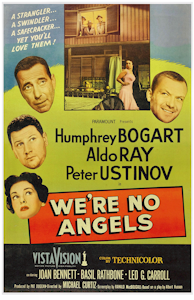
I refer, of course, to Humphrey Bogart.


As part of the Humphrey Bogart Blogathon, a whole bunch of folks are reviewing some of Bogie's films.  Most are picking the low-hanging fruit, and classics like Maltese Falcon and Casablanca were grabbed quickly.  The Wife is doing The Big Sleep, which is practically two movies - an early example (maybe the first for all I know) of a film that underwent a major re-write and came out a very different film at the other end of the process.

I chose a film that not only gave The Trenchcoated One a rare chance to show off his comedic muscles, but actually took place at this jolly time of year, allowing to serve not only as a contribution to the communal showing-off of trivia, but as a Christmas post as well.

We're No Angels (1955) was originally a play by Samuel and Bella Spewack, who among other things wrote the book for Kiss Me Kate.  It stars Bogie, Aldo Ray and the eternally delightful Peter Ustinov as three men who escape, just before Christmas,  from the Cayenne Penal Colony in French Guyana (colloquially known as Devil's Island).  They are hiding in plain sight in the town below, passing as parolees.  Their plan is to steal clothes from a local general store, fake up some papers and get outta the proverbial Dodge on a steamship anchored off coast, currently quarantined.

They enter the establishment of Felix Ducotel (Leo G Carroll) a man with a soft heart and a head to match, under the pretense of offering to fix his leaking roof.  As they spy from above, they learn the life of a mercantile owner is not a jolly one - he and his wife (Joan Bennett) are near ruin, what with his insistence on extending credit to everyone on the island.  His daughter Isabelle (Gloria Talbott) is pining for The One She Left Behind, a kissing cousin for whom she still holds a torch.  The three desperate men almost feel sorry for the family, commenting that there are more than one type of prison.  Things get worse, alas - Felix' cousin, and owner of the shop, Andre (Basil Rathbone) is out on the quarantined steamer, coming to review the store's books.  With him is his nephew Paul, Isabelle's beau, but he's been betrothed to the son of a shipping magnate.  Scarecely a merry Christmas.

The trio determine to do what they can to make the family's season bright - The beg borrow and (mostly) steal the trappings and settings for a proper Christmas dinner, so they can have fun while they can before Andre arrives. He arrives all too soon, demands to see the books and heads for bed.  And if wasn't for the fact that the convicts' pet adder Adolphe is in his bedroom, things would go quite badly indeed.  Bogie whips up a new will that names both Felix and Paul as heirs.  But it turns out that Paul is as big of a prat as Andre was, and promptly burns the will.  No worries - he finds Adolphe before our boys do, and considering they just came of a quarantined ship, two sudden deaths are as easy to explain as one.

This isn't a laugh-out-loud comedy, more the quiet smile at the wicket they've stuck themselves in variety.  There's a wonderfully slow scene as the three decide what they should do considering the fact that Andre has, unbeknownst to him, a deadly snake in his possession.  They slowly and deliberately choose which of the three should hurriedly rush in and warn him, eventually choosing to cut for the honor.  Bogie wins, starts a frenzied amble for the door, only to return, confessing he's forgotten the message.


What's fascinating about this film, aside from it being so entertaining,  is the fact that there's not a member of the main cast who hasn't appeared in one or two classic genre projects.  Even Bogie was in The Return of Doctor X.  Joan Bennett reached (in many eyes) her highest fame as grande dame of the Collins clan in Dark Shadows, and in her last film she played the first of Argento's Three Sisters in Suspiria.  Talbott is easily recognizable, even those horrofic bangs, as the titular "I" in I Married a Monster From Outer Space.  Rathbone was in too many horror and Sci-Fi films to even tabulate, and Aldo Ray had a great (albeit short) role as a man who follows orders to the letter in George Pal's The Power, a favorite in this home.  Ustinov did work in the genre years later, as the old man in Logan's Run.

While DVD copies of the film are going for collector's prices, it's available for electronic download and rental at Amazon.  It doesn't show up on TV at this season nearly as often as it used to, which may very possibly be connected to the fact that it is available for electronic download and rental at Amazon.

As a postscript, I note that the film's Wiki page starts with the disclaimer, "This article is about the 1955 film. For the 1989 film, see We're No Angels (1989 film)."  I cannot express enough how important it is that you do not follow Wikipedia's advice.

Friday, November 18, 2011

On great comic songs through history

OK, fair warning - this list probably doesn't have YOUR favorite superhero song. Over seventy years, there have been a lot of songs written about comic book and comic strip heroes. There's been musicals by the (wait for it...) score, like Annie, Lil' Abner, It's a Bird, It's a Plane It's Superman and even Doonesbury. There have been novelty numbers, serious songs, and some tunes so iconic they ended up in the movie adaptation of the hero decades after their creation. Ana amazing assortment of artists have contributed music to superhero films; even Jim Steinman (indisputable mastermind behind Meat Loaf's Bat out of Hell series) did a rendition of "Original Sin" for The Shadow.  And some years later, he got to write a few songs for the  Batman musical that Tim Burton was working on.  I write a bit about that over here on my Tumblr feed, where I post smaller points and thoughts.

Here's a short list of a few songs inspired by the comics you've likely heard of, and hopefully a few you haven't.