Saturday, December 24, 2011

On the effect of holiday cheer on escaped convicts

As we celebrate another holiday season, with its bustle and commercialism, it is all too easy to forget the man who was born this day.  A man who dedicated his life to making this a better world, and who was taken from us all too soon, leaving behind faithful people who copy his actions and mimic his words in an attempt to keep alive his lessons.

I refer, of course, to Humphrey Bogart.


As part of the Humphrey Bogart Blogathon, a whole bunch of folks are reviewing some of Bogie's films.  Most are picking the low-hanging fruit, and classics like Maltese Falcon and Casablanca were grabbed quickly.  The Wife is doing The Big Sleep, which is practically two movies - an early example (maybe the first for all I know) of a film that underwent a major re-write and came out a very different film at the other end of the process.

I chose a film that not only gave The Trenchcoated One a rare chance to show off his comedic muscles, but actually took place at this jolly time of year, allowing to serve not only as a contribution to the communal showing-off of trivia, but as a Christmas post as well.
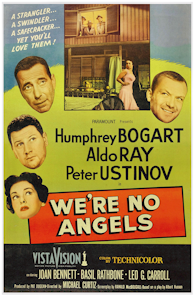
We're No Angels (1955) was originally a play by Samuel and Bella Spewack, who among other things wrote the book for Kiss Me Kate.  It stars Bogie, Aldo Ray and the eternally delightful Peter Ustinov as three men who escape, just before Christmas,  from the Cayenne Penal Colony in French Guyana (colloquially known as Devil's Island).  They are hiding in plain sight in the town below, passing as parolees.  Their plan is to steal clothes from a local general store, fake up some papers and get outta the proverbial Dodge on a steamship anchored off coast, currently quarantined.

They enter the establishment of Felix Ducotel (Leo G Carroll) a man with a soft heart and a head to match, under the pretense of offering to fix his leaking roof.  As they spy from above, they learn the life of a mercantile owner is not a jolly one - he and his wife (Joan Bennett) are near ruin, what with his insistence on extending credit to everyone on the island.  His daughter Isabelle (Gloria Talbott) is pining for The One She Left Behind, a kissing cousin for whom she still holds a torch.  The three desperate men almost feel sorry for the family, commenting that there are more than one type of prison.  Things get worse, alas - Felix' cousin, and owner of the shop, Andre (Basil Rathbone) is out on the quarantined steamer, coming to review the store's books.  With him is his nephew Paul, Isabelle's beau, but he's been betrothed to the son of a shipping magnate.  Scarecely a merry Christmas.

The trio determine to do what they can to make the family's season bright - The beg borrow and (mostly) steal the trappings and settings for a proper Christmas dinner, so they can have fun while they can before Andre arrives. He arrives all too soon, demands to see the books and heads for bed.  And if wasn't for the fact that the convicts' pet adder Adolphe is in his bedroom, things would go quite badly indeed.  Bogie whips up a new will that names both Felix and Paul as heirs.  But it turns out that Paul is as big of a prat as Andre was, and promptly burns the will.  No worries - he finds Adolphe before our boys do, and considering they just came of a quarantined ship, two sudden deaths are as easy to explain as one.

This isn't a laugh-out-loud comedy, more the quiet smile at the wicket they've stuck themselves in variety.  There's a wonderfully slow scene as the three decide what they should do considering the fact that Andre has, unbeknownst to him, a deadly snake in his possession.  They slowly and deliberately choose which of the three should hurriedly rush in and warn him, eventually choosing to cut for the honor.  Bogie wins, starts a frenzied amble for the door, only to return, confessing he's forgotten the message.


What's fascinating about this film, aside from it being so entertaining,  is the fact that there's not a member of the main cast who hasn't appeared in one or two classic genre projects.  Even Bogie was in The Return of Doctor X.  Joan Bennett reached (in many eyes) her highest fame as grande dame of the Collins clan in Dark Shadows, and in her last film she played the first of Argento's Three Sisters in Suspiria.  Talbott is easily recognizable, even those horrofic bangs, as the titular "I" in I Married a Monster From Outer Space.  Rathbone was in too many horror and Sci-Fi films to even tabulate, and Aldo Ray had a great (albeit short) role as a man who follows orders to the letter in George Pal's The Power, a favorite in this home.  Ustinov did work in the genre years later, as the old man in Logan's Run.

While DVD copies of the film are going for collector's prices, it's available for electronic download and rental at Amazon.  It doesn't show up on TV at this season nearly as often as it used to, which may very possibly be connected to the fact that it is available for electronic download and rental at Amazon.

As a postscript, I note that the film's Wiki page starts with the disclaimer, "This article is about the 1955 film. For the 1989 film, see We're No Angels (1989 film)."  I cannot express enough how important it is that you do not follow Wikipedia's advice.

Friday, November 18, 2011

On great comic songs through history

OK, fair warning - this list probably doesn't have YOUR favorite superhero song. Over seventy years, there have been a lot of songs written about comic book and comic strip heroes. There's been musicals by the (wait for it...) score, like Annie, Lil' Abner, It's a Bird, It's a Plane It's Superman and even Doonesbury. There have been novelty numbers, serious songs, and some tunes so iconic they ended up in the movie adaptation of the hero decades after their creation. Ana amazing assortment of artists have contributed music to superhero films; even Jim Steinman (indisputable mastermind behind Meat Loaf's Bat out of Hell series) did a rendition of "Original Sin" for The Shadow.  And some years later, he got to write a few songs for the  Batman musical that Tim Burton was working on.  I write a bit about that over here on my Tumblr feed, where I post smaller points and thoughts.

Here's a short list of a few songs inspired by the comics you've likely heard of, and hopefully a few you haven't.

Sunday, October 9, 2011

On The Man Who Got Plentiful Variants

The custom cover variant has become the new iteration of the marketing gimmick that is the alternate cover.  If a store buys enough copies of a book, the publisher will print a custom cover featuring the store's name.  IDW did it for Godzilla, and Marvel just did it for Spider-Man.

Nice way to get your customers excited, only slightly more controversial than the idea of gimmick covers in the first place, a topic upon which I have spoken before. Now, the goal in doing a variant cover is to entice buyers to buy EACH of the covers to keep their collections "complete".  But in this case, we're talking about dozens of covers, spread out to individual stores across the country.  Surely the attempt to collect a full set of those covers would be impossible. Right?

Wrong.

Bleeding Cool shares with us the exploits of Dough Boy (whose name, I must assume, refers more to his wallet than his physical consistency) who successfully collected a set of all 144 variant covers to Spider-Man #666.  I shall quietly point out that 144 = 1 gross.  Sometimes the English language is kind to writers.

Through a combination of trolling eBay, calls to individual shops and requests via Facebook for people to pick up copies for him locally (One cover was only available in Japan, for example) he was able to collect a full set for just shy of twelve hundred dollars.  Now, there's a definite sense of accomplishment in doing something that no one else has been able to do.  But IMHO, there's a greater sense of accomplishment when there's a large number of people who would WANT to do it. There's a lot of entries in the Guinness Book of World Records for things that damn near nobody would ever bother to try to do, let alone beat, except for the sole fact of it would get them in the Guinness Book of World Records.

I am in no position to cast the first stone here.   I have in my possession a complete run of the American Perry Rhodan books (Yes, including the Master Publications magazine releases - who wants to touch me?) a complete run of The Destroyer, and am one shy of a complete run of Doc Savage Paperbacks (Double edition 117 - 118, since you asked). Similarly, I have multiple editions of E.E. "Doc" Smith's Lensmen series, as well as the Lord of the Rings trilogy, including the "bootleg" Ace editions.  But those were out of my love for the books and series in question.  This seems much more like an attempt to Do What Has Not Been Done, as opposed to some spontaneous show of affection for the issue.

But back the industry.  These are the two most intriguing paragraph's from the over-moneyed and under-goaled gentleman's story:

One thing became clear during the chase...retailers for the most part were not prepared for the onslaught of communications from completionists.  I contacted numerous retailers who said they would get back with me whom never did, or did so after a month.  It was great to contact most retailers who understood the desire to own them all and they were more than happy to sell a copy at a reasonable rate and ship it.

There were some retailers who would refuse to communicate with non-local consumers, some retailers who would not mail under any circumstance, and some retailers who decided they were going to jack their cost way up to take advantage of the completionists.

Now in honesty, even though the cover price of a variant book is the same as a regular cover, it does cost more to the store, because in most cases they have to buy quite a few other titles just to get the right to buy the variant.  So if a particular cover requires the purchase of fifty copies of the standard cover, as an example, that one book effectively cost the store the cost seventy-five dollars or so, based on the average discount they get.  So if they never sell all those standard covers, they have to charge at least that much for the variant simply to break even.  The same holds true of "chase" trading cards - someone had to open a box or a case full of cards to find that card, so the cost needs to reflect that expense, since the majority of those other cards will not sell.

So I don't see it as "taking advantage" of the customer to charge a premium for these rare items.  If anyone is taking advantage, it's the publishers, taking advantage of the collector mentality of the market.

But let's look at the other times that a store will attract new customers.  When a book makes the papers, say when Captain America or Batman died, and then returned a few months later, or the Spider-Man / Barack Obama issue.  Those weren't variant issues, they were regular issues of a monthly title.  But they made the papers, so stores get besieged by newcomers keen on getting that book.  At that point, the stores have two basic choices:
  1. Make hay while the sun shines, work under the assumption that they'll never see these people again, and get what they can for this one-time sale
  2. See this as a possibility to get more regular customers, make up some coupons for a percentage off their NEXT visit, get a bunch of stuff on sale while the newcomers are coming through, and aim for more long-term income.

I think it's safe to safe to say the lion's share of stores went with plan one.

The best way, I feel, for a store to benefit from the variants and heavily publicized books is in getting new regular customers, and maybe a bit of press for yourself.  Say you score one of these hot variant covers.  You could slap a hundred-dollar price tag on it (and settle for a fraction of that a year or two from now), or you could, say, raffle it off, and donate the proceeds to a local children's hospital or charity.  One phone call to the local paper could get you a photo in the leisure section, which could attract more folks to your store.  Make sure your local TV station knows about the next hot comic, and see if you can finagle yourself an interview about it.  The media is very lazy - once they have your name and number, it's amazing how they'll declare you the local expert and consult you when any comic-related story crosses their desk.

I know it's hard to overlook that short-term payday, but with all the things happening to the industry today, anything you can do to increase your market, or at least your potential market, is a good thing to try. 

As an aisde, I'm rather pleased that at no point in this post did I accidentally misspell "variants" as "varmints".  That would have been way too Freudian.

Monday, October 3, 2011

On how we strive for Nick and Nora, but settle for Rob and Laura

This blog  post is a part of the Dick van Dyke Show blogathon, hosted by the folks at Thrilling Days of Yesteryear. Click the link to see a list of other folks touching on the same topic today.

I went the opposite direction from most kids.  I knew that what I saw on TV was pretend.  In fact, I knew this so well, I assumed that save for the news, EVERYTHING on TV was pretend, including cities. I assumed that not only were the people fictional, the places were as well. I mean I knew there was a New York City, but I knew there was no 704 Houser St. 

So this is why, until I was about 20, I didn't know New Rochelle was a real place.

I was driving up to Yonkers with The (eventually) Wife, saw a sign for the exit to New Rochelle, and honestly said "You mean it's actually a place?"  She looked at me like I had lobsters on my face.  "But that's where Rob and Laura Petrie lived!"  She assured me it was indeed a place, and the doors of my world opened just a bit wider.

The Dick Van Dyke show was one of my favorite sitcoms as I was growing up. I first saw Mr. Van Dyke (As most kids my age did) in Mary Poppins, and while the show was  far sight from the movie, it became regular viewing for me.Rob and Laura had the kind of relationship The Wife and I have - we have fun, we overreact to things, and while neither of write for a comedy show, we're as witty as the cast of the show.  As the title says, as much as we'd like to be Nick and Nora Charles (Heck, I'd settle for Ralph and Sue Dibny, without all the unpleasantness at the end, of course), we more often than not end up as Rob and Laura.

I've said for many years that Dick Van Dyke is an under-appreciated actor.  I've written about two of his films at The Wife's blog:  Cold Turkey, a vicious little bit of satire about a small town trying to quit smoking en masse to win a twenty five million dollar prize, and Fitzwilly, a caper flick with Dick as a con man butler who rooks the upper class of New York City, all to keep his bankrupt dowager boss from going to the poorhouse.  Neither feature much of his trademark physical comedy, but a lot more of his acting chops.

The Dick Van Dyke Show was much more the work of Carl Reiner, who created the show and appeared as Alan Brady, eponymous star of the show for which Rob wrote.  The show was clearly based on Reiner's work as a writer for the legendary Your Show of Shows, starring Sid Caesar.  The show featured a true Murderer's Row of writers - Neil Simon, Mel Brooks, Woody Allen, and many others cut their teeth on that show.  Carl's not the only one to dig into the show for inspiration - Neil Simon wrote Laughter on the 23rd Floor and Mel Brooks produced My Favorite Year, a fictional tale based in that legendary writer's room.  Few remember the short lived sitcom starring ex-Roseanne beau Tom Arnold called The Jackie Thomas Show, but after one episode I realized it was essentially an update of the Dick Van Dyke Show, but with the Alan Brady character taking more of a center role. Indeed, the same could be said of 30 Rock as well.

Picking a favorite episode of this series borders on the impossible.  But I knew there was going to be a near riot for the right the do "It only Looks Like a Walnut" (Brandie got it over at True Classics) so I went with another flying saucer epic, "Uhnny Uftz"


"Who's Sonny Tufts?"
Rob, Buddy and Sally are pulling an all-nighter at the office, and while the others are out getting coffee, Rob hears an unearthly sound and sees a flying saucer outside the window of his office.  Buddy and Sally return too late to see it, and assume Rob was asleep and dreamed it.  Rob is adamant, even as he explains that the saucer had lightning bolts on it like the comic strip star Brick Bradford, and the eerie ship spoke, saying what sounded like "Sonny Tufts".

Laura is no more receptive to Rob's tale, and chides him gently.  He gets no further when he reports the sighting to the government, and when his psychologist friend assures him that he really did likely imagine it, he lets it pass.  But after another all-nighter the next evening, Rob hears and sees it again.  This time, however, Buddy returns in time to hear the Gas Music From Jupiter, which they determine is now coming from somewhere upstairs in the building.

Exploring the floor above, they are confronted by a man who seems to know about the saucer, and is most distressed that it had any witnesses.  After a seemingly threatening request to enter his office, he reveals that there really is a saucer, but it's a toy, and the secrecy is to make sure the invention isn't stolen before Christmas.  Rob and Buddy agree to keep mum i exchange for one favor - a five minute chance to spin the thing around the room.

Dick Van Dyke gets the chance to do a bit of schtick, lots of fright reactions and bit of work up on the office windowsill.  He also excels at talking to himself, and has a fun scene as he listens to perfectly normal sounds that seem terrifying at three in the morning when you're only person in a huge office building.

Two notable guest stars in the episode - Madge "Aunt Harriet" Blake as a batty lady at the Metro North station who claims to have seen the saucers as well, and that little old toymaker was John Mylong, who played the elder scientist in the infamous masterpiece Robot Monster.

This is an episode I saw the first half of as a kid at my grandmother's house, and had to head for home before the payoff.  I didn't see the end of the episode for almost ten years, so needless to say I was primed to learn the secret of the mysterious saucer.

I've done a lot of things...but I would never Uhnny Uftz you.

Saturday, September 3, 2011

On the untapped potential of a world with seventy years of superheroes

Last time I talked about the past of Earth-Two. This time I'm going to talk about its future.

I've discussed it before - the "Sliding years" theory.  The idea that all the years of comic book adventures you've ever read of any character all took place in a far more compressed time period, and took place in the past few years, as opposed to the fixed point in the past when it was originally published.  Case in point - the Fantastic Four were first published forty years ago, but in the internal fictional timeline of the Marvel Universe, they haven't been active for that long.  Back in the 80's John Byrne opined the period was seven years; now, another couple decades later, it could be as much as twelve to fifteen years, as Grant Morrison has estimated for Batman's career.

For TV fans, look at this way - All the episodes of M*A*S*H, ten years of them, had to have all taken place during the three-year period of the Korean War.  So you have to (you should pardon the expression) mash events together - several of the Christmas episodes were all the SAME Christmas, for example, just different looks at different events.

In the new post Flashpoint world of the DCU, the period has been shrunk back to about five years.  So not only did a lot of the stories we've read not had time to happen, the world as a whole has barely had time to get used to the idea of superheroes, and be changed by them.

Depending on how old you are, think back to big things that happened to the world in the past, and how amazing they were, and how long it took the world to get used to them.  Stuff like the fall of the Berlin Wall, people on the moon, even the Internet; think about how the world changed to adapt, to add these events into its paradigm.  Five years isn't that long. There's still going to be people who are suspicious of superheroes, some who still think they're all a hoax.

Now envision a world that has had superheroes for seventy years.

Earth-2 is back, and with it, the Justice Society of America, who fought crime, and the Axis, in World War II.  In the old days, the all or nothing days, the Pre-Crisis Days, "Earth-Two" was that world - the JSA fought as far back as WWII, and never stopped.  Some people took up the job inspired by them, some heroes had kids who joined the family business, and generally, it was a very different world from the main Earth of the DCU.

That alone is a great reason to bring it back.  It's the opportunity to generate a parallel brand, in the way that Marvel has the Ultimate line, and the WWE have Raw and Smackdown.  Make them different enough, and you'll have fans of each one separately. One of the problem with the DCU is they've got so many great characters, there's no place to find a spot in the limelight.  It's EXACTLY why the WWE broke up their two shows.  Two champions, two rosters, twice the chance to rise to the top.  The Marvel Ultimate Universe is basically the same characters twice, with different histories and different stories being told about them.  Earth 1 and 2 can be ENTIRELY different worlds, with wholly different heroes. 

Assuming they don't get their own Superman again (and I hope they don't), who would be the most powerful hero of Earth-2?  My guess is, we haven't met him yet. And that's AMAZINGLY cool.  On the whole, save for Dr. Fate and The Spectre, the general power level of the Earth-2 heroes was quite a bit lower.  There were a lot more costumed humans than there were super-humans.  That was mainly because in the early days of comics, they simply hadn't stretched their imaginative wings far enough yet.  But if you take one of Dan Didio's comments to its extreme, if a less powerful Superman, one who could be injured, is more dramatic and exciting, than a normal human who chose to train a bit and put on tights can be even MORE dramatic, no?  We could see a lot more of that in a new Earth-2.

You know who would be PERFECT on Earth-2. Ted Fucking Kord.  On Earth-1, characters like Blue Beetle were utterly overshadowed by the top echelon on power. But on a more "Down-to-Earth" Earth?  He could be near the top.  So too characters like Gangbuster.

Let's think about the social effect  that the existence of seventy years of actual Superheroes would have on a world.  Consider - right now, in this world, becoming a superhero is officially the act of a crazy person.  And we have dozens of them.  On our Earth, you tell your parents you want to be a superhero when you grow up, they either pat you on the head, or take you to the psychiatrist.  On DCnU-Earth, they'd say, "One of those crazy people?  You'll break your neck!"  Say it on Earth-2, and they'll say, Well, you better drink your milk and finish your homework, they don't let lazy-bones in the Justice Society".  "Superhero" is a valid and viable career option. 

In the more educated to the concept audience that modern readers have, a really bold writer could take the alternate history to amazing lengths.  Roy Thomas was ever forced to come up with reasons why the JSA didn't all just to fly over to Germany and kick Hitler's ass. He created the magical barrier, created by the Spear of Destiny, which prevented the Amerikanisher Schweiner from entering the theater of war. 

Now, imagine a world where they could.  The war never got as far as it did, the A-bomb was never dropped. Aliens have been attacking earth for decades, and we collect up the technology, reverse-engineer it and advance humankind at quantum speed.  The present of Earth-2 might not be a Utopia, but it could be a very interesting place to be.

If DC brings back Earth-2 exactly as it was, how many readers is that going to attract?  Well, what was the print run of the last issue of JSA that came out last week?  THAT'S how many.  It's not going to pull any old-time fans back - the ones that want the JSA back that badly are still reading comics.

But a world that has had superheroes for almost a century, and has been growing and changing as a result of it for all that time?  A world lifted and changed, literally on the shoulders of heroes?  They can SELL that.

Friday, September 2, 2011

On the return of an old friend, and the six billion people living on it

Earth-Two. Say it to an older comic fan (raises hand) and watch their eyes well up.

When superhero comics first appeared in the 40s, heroes from the three companies that eventually became DC Comics teamed up and formed the Justice Society of America.  The team appeared till the end of 1950, when the superhero genre as a whole started to wither, save for the "Trinity" characters, Superman, Batman and Wonder Woman, who kept right on going.

Six and change years later, DC decided it was time to bring the superheroes back. But rather than revive the existing characters, they chose to create new ones with the same names and similar powers.  They started with The Flash, in Showcase #4.  As a tip of the hat to the characters of the past, it was revealed that the new Flash, Barry Allen, read The Flash comics, and that was why he was inspired to become a superhero, as opposed to, I dunno, getting to a doctor and having himself checked out after getting doused with chemicals and lightning.

That's a facet of Barry Allen that gets rather short shrift today - he was a comics fan.  He read and collected comics, and was inspired to do good by them.  More than ever before, this was a hero fans could identify with.

Showcase did very well, and a continuing Flash title soon followed, as did new "Silver Age" versions of lots of other characters.  And a very interesting thing happened.  DC started getting letters from readers who wondered what had happened to those older characters, and if they could see them again.  This rather surprised DC, who assumed that the comics readership was  constantly rotating, and that in the past six years all the old readers had long since moved on.

So they had a brainwave.  In keeping with the more science-based motif of the new books, they explained that the adventures of the heroes of World War Two took place on a parallel earth, like ours in many ways, but with a slightly different history, namely with superheroes appearing in the pre-WWII era.  They even had their own "Trinity" heroes, which neatly explained how Superman, Batman and Wonder Woman could have fought Hitler and still look just the same in the mid-50s.

So Barry Allen met Golden-Age Flash Jay Garrick in the nigh-legendary "Flash of Two Worlds", and started a tradition that would last twenty years.  Soon the entire Justice League of America met their Earth-Two counterparts, the Justice Society, and would every year for decades.

They didn't stop there.  Earth-Three was an evil opposite of the other earths, with the super-powered denizens their worst criminals.  As other companies' comics characters were purchased over the years, they usually got their own Earth, to explain how their adventures could have happened.  The Quality Comics characters like The Ray and Phantom lady were put on Earth-X, another "Alternate History" Earth, one where World War Two was still raging into the eighties, which gave their heroes, the Freedom Fighters, a chance to keep doing contemporary stories against the Nazis.  When DC licensed the Fawcett characters, They ended up on Earth-S, for "Shazam".  The Charlton characters got their own earth for all of five minutes or so, as it was introduced and destroyed mere pages apart in Crisis in Infinite Earths.

Crisis (so important is it in DC History, it can universally be spoken of as a single capitalized word) was intended to "simplify" the "Complicated" history of the DCU.  The whole multiple Earth thing was seen as daunting to new readers, which the company certainly wanted to attract.  So Crisis wiped the slate clean.  There was now only ONE Earth, upon which the JSA fought during WWII (albeit without Superman, Batman and Wonder Woman), and some decades later, modern heroes appeared, some bearing the same names as the earlier heroes.

Of course, that meant that a great number of stories no longer "happened", or happened with different details.  Many events happened at a different period, and indeed, even Crisis, which we'd just read, was now substantially different in continuity than as we'd just read it.

Sound familiar?


The JSA was the biggest casualty of the event.  Aside from being slapped into a history they never made, it was decided that the characters were too old for the readership, and in a story released around the same time as Crisis, they volunteered to fight an eternal battle in a magic dimension to stave off Ragnarok.


I don't know how "complicated" the idea of parallel worlds is, especially to a reader of comics and science fiction. I first learned about Earth Two when I was seven, specifically in Flash #229.  It was explained in one panel, and it made PERFECT sense. I didn't know who who this "Jay Garrick" jasper was, but the idea of a whole 'nother Earth full of heroes was amazingly cool, and sealed me to DC even more.  I mean, Marvel just had the ONE Earth, and everyone on it seemed so...depressed.

(Dig the way they drew Earth-Two for a while, with the land and sea-masses reversed.  I can only imagine the ecological nightmare of an earth with twice as much land as water...)

After just about the same period of time as their last break from action, the JSA were brought back again and given a new series which was VERY quickly cancelled, to the surprise of the fannish community.  They were then soundly put down in a later event, Zero Hour, Crisis in Time, where a number of them were killed in battle.

But you can't keep a good team down.  After yet ANOTHER event, Infinite Crisis, the team was revived again, this time under the hand of James Robinson, and shortly thereafter, one Geoff Johns. 

Immediately after Infinite Crisis, a weekly title, 52, made the revelation that parallel Earths were back.  Not the full-blown multiverse of the past, but a set of 52 Earths, most of which have been identified.  They're not the SAME worlds of the pre-Crisis multiverse, but many are very similar.  There's a version of the Marvel Family on Earth 5 (instead of "S") alternate versions of the Charlton heroes on Earth 4, and the Quality characters on Earth 10 (instead of "X", the Roman numeral for 10), also featuring Nazi versions of other DC heroes. 

Note that while the Pre-Crisis Earths were spelled out, the "Post 52" Earths use numbers.  That was a deliberate choice to show the difference between the two versions.


And there's an Earth-2, which features a different version of the JSA from the one on the "main" earth, alternately known as either New Earth or Earth-0.  It had the most similar history to its pre-Crisis counterpart. It looked for all the the world to be the Pre-Crisis Earth-Two a world in which the timeline continued on after Crisis. A story Geoff Johns wrote for the JSA annual had Power Girl return there, and we got a look at what looked essentially like Earth-Two would have looked like if it had survived Crisis.  tantalizing, to say the least.

Well, now there's been one more event, Flashpoint, and this time, the JSA have been wiped off the board entirely.  The first superheroes in the world are the modern versions of Superman, Batman, Green lantern, et al, and what's more, even their histories only go back five years.

Fandom's reaction was white-hot and brutal.  Fans were not ready to let these characters get taken away again.  But never fear; DC wasn't going to wait another six years this time.  Even before the book in which the reboot happened could be released, DC announced that the JSA would indeed be back, in a new project written by James Robinson, and drawn by Nicola Scott.

But didn't they just get finished telling us that the JSA was gone from the new history?  Yep.  The JSA were moving back to their traditional home, Earth-2.

I'll lay odds some folks wept openly.

But here's the question I've been asking...Is it going to be Earth-2...or Earth-Two?

Either way, it's going be a fun adventure.

In part two of this rambling I'm going to talk about how if they play their cards right, and take advantage of the opportunity of a blank slate, Earth-2 could end being DC's Ultimates universe.

Wednesday, August 31, 2011

On the end of Flashpoint, and the start of a New Universe

Right, well THAT'S over.

Flashpoint has brought the DCU that I grew up with, the one that all of my childhood memories are connected to, have been brought to an end.  The various books tried to bring their stories to a nice coda, and all told they did a good job.

Flashpoint #5 brought this latest event to an end, and started off the new DC Universe.  While it took place in a world greatly unlike our own, it was ultimately a story of two men, Barry Allen and Thomas Wayne.

Interesting bookend - at two times in his life, Barry causes chaos by attacking the Reverse-Flash in the timestream.  Once by "killing" him in the original run of his book, and now by trying to undo the massive changes Thawne had  made to time.

I don't like the idea that Barry doesn't get his parents back. From the moment that was changed in Flash: Rebirth, I didn't care for it.  Barry Allen was always the character in the DCU having the most fun.  He was married, had a nice set of parents, and an addlepated father-in-law.  Of all the heroes, he was the one most likely to be smiling.  But the events of rebirth had him saddled with a horrific history - now his Mom was killed, presumably by his father, who was taken to jail for it.  What a change!  But once it was revealed, gloatingly, that the Reverse-Flash was responsible for it, it was almost unfair that it couldn't be undone.

Perhaps the info in Flash #1 will prove me mistaken, but the end of FP #5 has me thinking his parents are still dead, he knows that Thawne is responsible for their death, he remembers his history of the alternate timeline, but might not recall that Thawne is dead. Not as satisfying an ending for him as I'd like.You could argue that Thawne won, dead or no.  And he's a time traveler; there's really nothing stopping him from coming back.

The tie-in books were as advertised - they were entirely ancillary, and did not have to be read at all to further the plot of the main book.  While they were all interesting, I can't say I agreed with the choices of who got books and  who didn't.  I'd have happily traded Legion Of Doom for, say, a S!H!A!Z!A!M! mini.  The two I enjoyed the most were Project: Superman and The Outsider.  I would not mind seeing either The Outsider or Project Zero make their way to the DCnU.

My biggest disappointment of the tie-ins was Booster Gold, not because of any failings in the story, but for what I presumed / hoped his role would be.  Being as they went to such lengths to point out that his was the only regular title crossing into Flashpoint, I took that to mean he'd play more of a role in the proceedings.  But ultimately, he faced Doomsday (again - that is a character that has absolutely been overused, and one I will not miss.), tapped into Flash's Speed Force, and went home. Didn't get to fix anything, didn't even get to save the girl.

Oh yes...the girl.  Alexandra had parasite-like powers, and at the moment before she, oh let's say "Died", Booster was trying to travel through time. And then a mysterious figure wrote the words on Rip's blackboard, and at the tie same time a mysterious hooded figure helps guide Barry to the right path to fixing things as near as can be.

Connection?  Who the hell knows?

The mysterious hooded lady is clearly the beginnings of another over-arc.  Not an event, per se - Dan Didio has sworn blind we won't get one of those for some time. But she's already been sighted in preview copies of other first issues, so she certainly seems to have a role to play.

Justice League #1 looked very promising, and was a very nice start to the new Universe.  It had a couple clunkers ("He combusted into fire"...peewwww) but it did a good job of giving the feel of how things now are. 

There's not a single title I don't want to give a fair look, there's several I'm quite keen on, and a few I'm right chuffed about. 

There's still a LOT of questions I have about the timeline of the DCnU.  With only five or so years of history in place, there's simply no time for ALL the events we've read about to have happened, either in whole or in part.  The lesser event books alone are likely all gone - I will not be sad to see Armageddon 2001 to go out the door, and Amazons Attack...please. 

I may try to go into more detail about these questions over the next week, but let's just ask about a few tentpoles here...

Who's died? The events of Batman RIP have likely occurred, as they funneled directly into Batman Inc, which is firmly underway as this new world starts up before us.  But was it still at the hands of Darkseid?  Did Final Crisis happen as we read it, if at all? 

Superman?  Did he die at the hands of Doomsday and come back?  We know Superboy's origin is all new now; Is Steel in the DCnU, or just some iteration of John henry Irons? 

Or what about Hal Jordan?  Geoff Johns did a great job or winnowing away the effects of Emerald Twilight from Hal's life - maybe this is the chance to wipe it away entirely?  If Superman didn't die, did Hank Henshaw destroy Coast City?  Hal could still have been possessed by Parallax and gone on a bit of a tear, but could have been stopped before he died.  We know Kyle Rayner has a ring in the new continuity, but who's to say he got it the same way, as a result of the same exact tragedy?

Let's go back to the first big one - with only one Flash in current continuity (that we know of - they're being deucedly cagey about Wally), did he ever die?  Did Crisis ever happen?  If not, Flash may never have died, which means that even more of the events of Final Crisis are under flux.


A lot of questions.  In full fairness, not all require an answer to permit enjoyment of the new books, but when people have upwards of 70 years of continuity in their heads, it's a fair question to ask how much of it will be of value in the future, as opposed to just being useful in talking about the past.

Which I expect I'll do a lot.